
Puerto Rico travel guide
About Puerto Rico
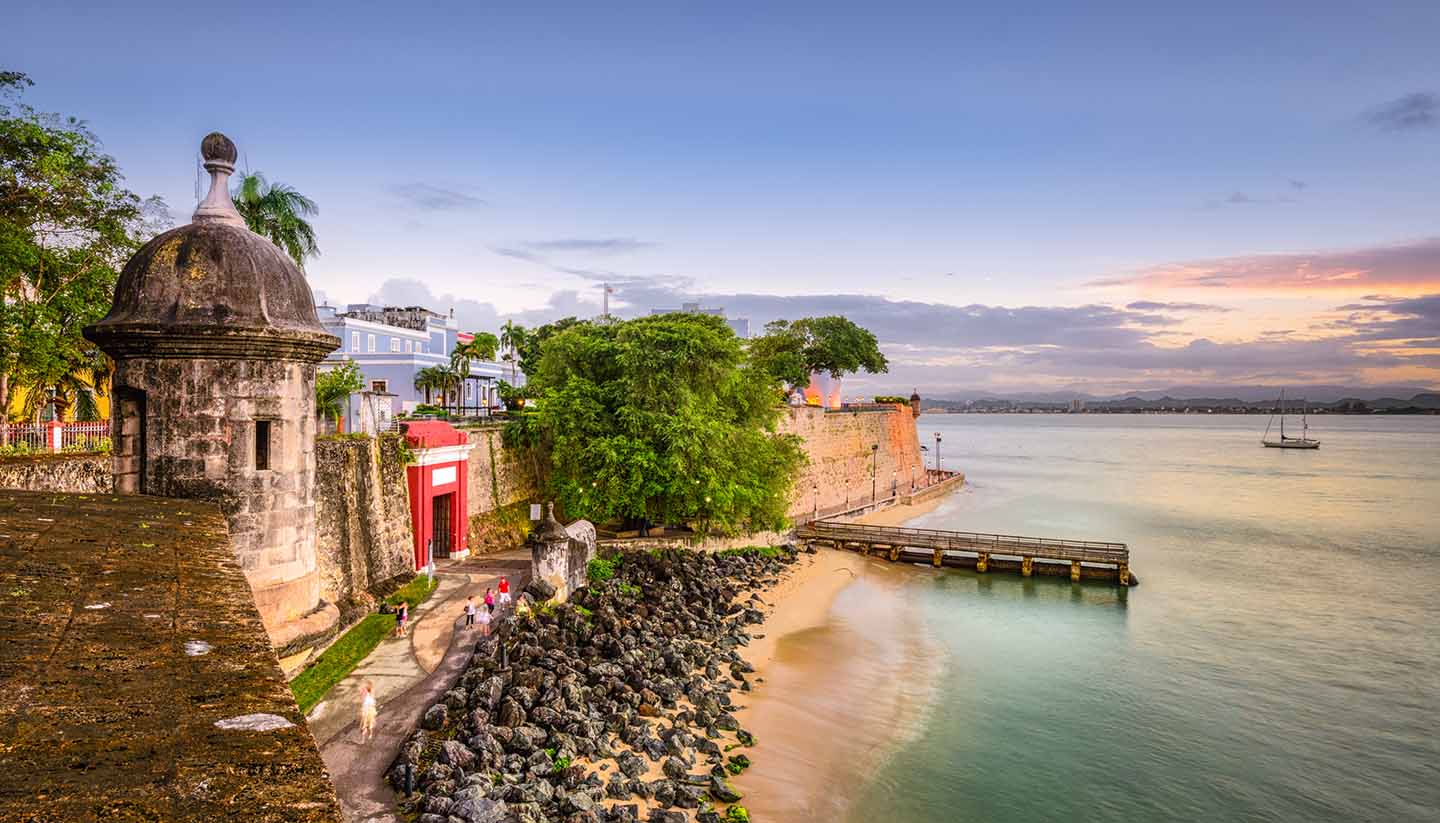
Think palm-fringed beaches, colourful colonial buildings and a harmony of Caribbean, Hispanic and American cultures, and you’ve got Puerto Rico in a nutshell. A coconut shell, of course. Add to this swathes of tropical rainforest, warm turquoise waters and year-round sunshine and you have all the hallmarks of a perfect holiday destination.
Most visitors flock to Puerto Rico to bask on its pristine sands. From Rincón’s rip-roaring swells to the nearly deserted shores of Vieques where wild horses roam, there really is sand and surf for every type of beach bum. Puerto Rico also has three rare bioluminescent bays: glow-in-the-dark bodies of water that produce a nighttime lightshow for kayakers and boat tours.
Inland, epic landscapes and cultural attractions abound. The central mountain range is riddled with limestone caves and rugged forest trails. El Yunque National Forest, by contrast, is a lush expanse of rainforest, with waterfalls and Taino petroglyphs. The Conservation Trust of Puerto Rico's various sites offer visitors a taste of the island’s colonial history, including Hacienda Buena Vista, an old coffee plantation, and Hacienda Esperanza, an old sugar plantation.
Culturally, Puerto Rico integrates three “roots”: Taino (an indigenous group), Spanish and African. The country is in the Caribbean, but not wholly of it, influenced also by Latin America and the USA, with which it has a colonial relationship. The American influence is visible through ubiquitous US flags, shopping malls and baseball, the national sport. Historical Spanish influences are well preserved. Old San Juan is home to two UNESCO World Heritage sites, with blue cobblestone streets and pastel-painted colonial buildings.
This blend of cultures makes for interesting music, food and festivals, as well as some quirks of daily life (the Spanish and English languages are fused resulting in some interesting names). Preserving cultural heritage is what Puerto Ricans do best, and it’s what draws visitors back again and again. That and the beaches, of course.
Key facts
8,870 sq km (3,425 sq miles).
3,680,772 (UN estimate 2016).
405.7 per sq km.
San Juan.
Self-governing US Commonwealth Territory (incorporated).
President Donald Trump since 2025.
Governor Jenniffer González Colón since 2025.
Travel Advice
This travel advice also covers American Samoa, Guam, Northern Mariana Islands, Puerto Rico, and United States Virgin Islands.
Before you travel
No travel can be guaranteed safe. Read all the advice in this guide. You may also find it helpful to:
- see general advice for women travellers
- read our guide on disability and travel abroad
- see general advice for LGBT+ travellers
- read about safety for solo and independent travel
- see advice on volunteering and adventure travel abroad
Travel insurance
If you choose to travel, research your destinations and get appropriate travel insurance. Insurance should cover your itinerary, planned activities and expenses in an emergency.
About FCDO travel advice
The Foreign, Commonwealth & Development Office (FCDO) provides advice about risks of travel to help you make informed decisions. Find out more about FCDO travel advice.
Get travel advice updates
Sign up to get email notifications when this travel advice is updated.
Follow FCDO:
This information is for people travelling on a full ‘British citizen’ passport from the UK. It is based on the UK government’s understanding of the current rules for the most common types of travel.
You must have the correct approval prior to travel. This will be either a valid US visa or Electronic System for Travel Authorisation (ESTA), depending on your personal circumstances and purpose of travel.
US authorities enforce entry rules strictly. If you do not have the correct immigration status, or if you breach the terms of your entry, there is a risk you may be detained, refused entry, or removed (deported). Overstaying your permitted time in the US can also lead to detention and future bans on re-entry.
A valid ESTA or visa does not guarantee you will be allowed to enter the US. Authorities may refuse you entry if, for example, they believe you plan to stay longer than permitted or have provided inaccurate or incomplete information. The US may change the conditions to travel to the US at any time without prior notice.
If you’re not sure how these requirements apply to you, contact the US Embassy or a consulate in the UK. See information from US Customs and Border Protection on entry for international visitors.
Passport validity requirements
To enter the US, your passport must be valid for the length of your planned stay.
If you’re travelling through another country on your way to or from the US, check the entry requirements for that country. Many countries will only allow entry if you have at least 6 months validity remaining on your passport.
Dual nationals
When returning to the UK, British citizens must carry a valid British passport or certificate of entitlement. See Dual citizenship.
British-US dual nationals
US law requires US citizens to enter and exit the US using a US passport. Contact the US Embassy or a consulate in the UK for more information.
Visa requirements
To enter or transit through the US, you must have either an Electronic System for Travel Authorisation (ESTA) or a visa.
The US State Department has more information on visas.
Travellers whose sex on their passport differs from their sex recorded at birth should contact the US Embassy or a consulate in the UK for further advice.
Applying for an ESTA
ESTA is an automated system that determines the eligibility of visitors to travel to the US under the Visa Waiver Program (VWP). You can apply for an ESTA via the Official ESTA Application Website or using the ESTA Mobile app on android or on iOS.
All Visa Waiver Program (VWP) travellers intending to enter the US by land, sea and air will be required to obtain an approved ESTA prior to application for admission at land border ports of entry. Individuals who are not eligible to travel under the VWP may apply for a visa at any U.S. Embassy & Consulates.
You may not be able to apply for an ESTA visa waiver if you have:
- been arrested (even if the arrest did not result in a criminal conviction)
- a criminal record
- been refused admission into, or have been deported from, the US
- previously overstayed under an ESTA visa waiver
Information on whether you are eligible for an ESTA visa waiver can be found in the help section of the official ESTA Application Website.
You cannot normally apply for an ESTA visa waiver if you were in the following countries on or after March 2011:
- Iran
- Iraq
- Libya
- North Korea
- Somalia
- Sudan
- Syria
- Yemen
You cannot apply for an ESTA visa waiver if you travelled to or were in Cuba on or after 12 January 2021.
If your ESTA does not contain the required selfie photograph now required by US Customs and Border Protection, you may need to apply for a new ESTA. You should check your ESTA account before travelling to ensure your authorisation remains valid.
An ESTA may not be sufficient for all types of business travel – particularly if you are travelling on behalf of a US company. Please check the rules on the ESTA website carefully.
If you are not eligible for an ESTA, you must instead apply for a US visa. Travelling on an ESTA when ineligible can lead to detention and deportation by the US authorities.
Applying for a visa
The US Embassy in London has information on how to apply for a visa. Please check the guidance carefully.
US visa appointments
Visa appointments at the US Embassy in London are limited. Plan your application as far ahead as possible before travel. If you need to travel urgently, you can request an expedited interview through the US Embassy’s appointment service provider.
The US Embassy has more information on visa appointments.
Children and young people
Anyone aged 17 and under must:
- have a valid visa or ESTA on arrival
- be able to provide evidence about the purpose, location and length of their visit if asked by immigration officials
- have a letter of consent, preferably in English and notarised from one or both parents if travelling alone, with only one parent, or with someone who is not a parent or legal guardian
The US authorities can stop you entering the country if they have safeguarding concerns about a child. If this happens, the US authorities will take the child into their care, and their return from the US could take months. The FCDO cannot speed up the return of British nationals aged 17 and under from the US.
The US government has information about children travelling to the US. If you have questions, contact the US Embassy in the UK.
Vaccine requirements
For details about medical entry requirements and recommended vaccinations, see TravelHealthPro’s US guide.
Ebola
As a public health measure, the United States has introduced temporary entry restrictions for travellers who were recently in the Democratic Republic of the Congo, Uganda or South Sudan. See Information for travellers returning from Ebola-affected areas. Consult your airline before travelling.
The World Health Organisation (WHO) has declared this a Public Health Emergency of International Concern.
Electronic devices
Officials may ask to inspect your electronic devices, emails, text messages, and social media activity. If you refuse, they can delay or deny your entry. US Customs and Border Protection has more information on electronic device searches.
Customs rules
There are strict rules about goods you can take into or out of the US. You must declare anything that may be prohibited or subject to tax or duty.
Global Entry
The US Customs and Border Protection Trusted Traveller Program (TTP) Global Entry allows pre-approved, low-risk travellers expedited clearance at some US airports. If you’re a British citizen, you can register to get a UK background check. If you pass the background checks, you’ll be invited to apply for Global Entry for UK Citizens. Check eligibility carefully.
Terrorism
There is a high threat of terrorist attack globally affecting UK interests and British nationals, including from groups and individuals who view the UK and British nationals as targets. Stay aware of your surroundings at all times.
UK Counter Terrorism Policing has information and advice on staying safe abroad and what to do in the event of a terrorist attack. Find out how to reduce your risk from terrorism while abroad.
Terrorism in the USA
Terrorists are very likely to try and carry out attacks in the US.
Terrorism attacks could be indiscriminate, including in places visited by tourists and foreign nationals such as:
- crowded places and mass gatherings
- transportation networks
- sporting and cultural events
- places of worship and religious sites
- hospitals and clinics, schools and universities
Stay aware of your surroundings, keep up to date with local media reports and follow the advice of local authorities. The US Department of Homeland Security provides alerts within the US and its territories. If there is a life threatening emergency, call 911. US authorities regularly report that they have disrupted planned attacks and made arrests. Report suspicious activity to local law enforcement authorities.
Crime
Protecting your belongings
Do not leave passports in rental cars, especially not in the boot. Gangs may target vehicles driven by people who look like tourists.
Violent crime
Violent crime and gun crime rarely affect tourists, but take care in unfamiliar areas. Try not to walk through quieter areas alone, especially at night. You can find public advisories and information about recent incidents on local law enforcement websites.
Mass shooting incidents can happen but are a very small percentage of murders. The US Department of Homeland Security has advice on what to do in an active shooter incident.
Research your destination before you travel and follow the advice of local authorities. Crime linked to illegal drugs is a major issue in Mexican states bordering Arizona, California, New Mexico and Texas. Some foreign nationals have been victims of crime in the border regions, but there is no evidence they were targeted because of their nationality.
Protests
Protests are common and can become violent. Follow the instructions of local authorities who may introduce curfews or emergency orders. If you attend peaceful protests or mass gatherings:
- be mindful of your surroundings
- move away if there are signs of trouble
- follow the instructions of local authorities
Laws and cultural differences
US states may have different laws. While you are in a state, you are subject to both that state’s laws as well as national (federal) law. Not adhering to all US state and federal law can put your visa status and future travel to the US at risk.
Personal ID
Always carry a passport showing you have permission to enter or remain in the US.
Alcohol laws
The national legal age for buying and drinking alcohol is 21 across the US.
Illegal drugs
Illegal drugs, including cannabis, carry severe penalties. You should expect a long jail sentence and heavy fines for possessing, using or smuggling illegal drugs, including when transiting through airports. US law prohibits the importation, exportation, manufacture, sale or transportation of drug paraphernalia. If you are convicted of any of these offenses, you will be subject to fines and imprisonment.
Airports in USA have excellent technology and security for detecting illegal items. This is also used to scan the baggage of transiting passengers. All persons arriving at a port-of-entry to the United States are subject to inspection by U.S. Customs and Border Protection (CBP) officers.
Check state laws to make sure you follow laws on possession and use of controlled substances. The US Department of Justice provides a list of all controlled substances.
LGBT+ travellers
The US is a very diverse society and attitudes towards LGBT+ people differ hugely across the country. Check state and local laws for the areas you plan to travel to. Refer to entry requirements which may apply to LGBT+ travellers (see entry requirements).
Read more advice for LGBT+ travellers.
Outdoor Activities
If you’re taking part in organised outdoor activities, check that the company is reputable and has documented safety procedures.
For sports activities like skiing, potholing and mountaineering, and for sports classed as particularly dangerous (for example off-piste skiing, mountain biking, climbing or paragliding), your insurance should include:
- mountain rescue services
- helicopter costs
- repatriation to your country of residence or possible transfer to neighbouring countries for treatment
Hiking
- Check weather forecasts and conditions and make sure you’re properly equipped for the worst-case scenario with items such as a map, compass, GPS and telecommunication equipment.
- Risks are greater if you undertake any activity alone. You may want to hire a guide for expert advice. Always leave copies of your itinerary with someone.
- Check the US National Park Service website for additional advice.
Winter sports
- Read about preparing for winter sports abroad.
- Take advice on weather and avalanche conditions before you travel. Follow local skiing laws and regulations.
- Off-piste skiing is very dangerous and can invalidate your travel insurance. Avalanches are a risk in some areas. Follow safety instructions carefully and go with a qualified guide. Check ahead on the National Avalanche Center website
Transport risks
Road travel
If you are planning to drive in the US, see information on driving abroad and check the driving rules in the states you’ll be visiting.
You can use a UK photocard driving licence to drive in the US. You may need to get the 1949 version of the international driving permit (IDP) as well. IDP requirements vary in each state. For more information, consult individual states’ Department of Motor Vehicles as well as the American Automobile Association (AAA).
You cannot buy an IDP outside the UK, so get one before you travel.
If you still have a paper driving licence, you must take another form of photo ID, such as your passport. You can also exchange your paper driving licence for a photocard licence.
Hire car companies often have stricter requirements for their customers, such as a year of driving experience, a higher minimum age and holding an IDP.
Vehicle safety
When travelling by car, you should:
- check weather conditions before a long car journey, particularly in mountainous, isolated or desert areas where services may be limited
- not sleep in your car by the road or in rest areas
- avoid leaving any items on display in your car
- stay on main roads
- use well-lit car parks
If you’re in an accident, ask any other drivers involved to follow you to a public place and call the police.
Petrol stations
Petrol stations that do not display the price of fuel usually charge considerably more than the national average. They’re often close to tourist destinations and airports. Make sure you know the price of fuel before using these services.
Air travel
Before you travel, check the security measures you’re likely to face at the airport on the Transportation Security Administration (TSA) website. If you have a medical condition or disability and need assistance, contact TSA Cares.
To monitor airport conditions in the US, check the Federal Aviation Administration website.
Extreme weather and natural disasters
Find out what you can do to prepare for and respond to extreme weather and natural hazards.
Snowstorms
Snowstorms can disrupt critical infrastructure, and cause power cuts, or delays and cancellations in major transport hubs. Contact your travel company or airline before you travel.
Hurricanes
The Atlantic hurricane season normally runs from June to November. The Pacific hurricane season normally runs from May to November. Hurricanes can affect coastal regions, Hawaii and Guam. The South Pacific tropical cyclone season normally runs from November to May and can affect American Samoa.
The US National Oceanic and Atmospheric Administration’s (NOAA) seasonal outlook predicts a “below-normal Atlantic hurricane season” and an “above-normal hurricane season in the central Pacific basin”, including the waters around Hawaii in 2026. Travellers to the USA during hurricane season should check the websites of local, State and Federal agencies (such as NOAA and the US National Hurricane Center) for the latest forecasts and conditions. You should also be aware of the possibility of disruption to flights and other transport services.
You should:
- monitor approaching storms on the US National Hurricane Center website
- follow instructions from local authorities, including evacuation orders
- visit the Federal Emergency Management Agency (FEMA) website for information on preparing for extreme weather and evacuatingCheck with your airline or travel agent about possible disruption to flights or airport services and follow their advice
Earthquakes
While earthquakes can happen anywhere without warning in the US, Alaska, California, Hawaii, Oregon, Puerto Rico, Washington and the entire Mississippi River Valley are at higher risk for earthquakes.
The FEMA website has advice about what to do before, during and after an earthquake.
Tornadoes
Tornadoes can happen anytime depending on weather conditions. The FEMA website has advice about what to do before, during and after a tornado.
Volcanic eruptions
There is volcanic activity across parts of the US with Alaska, Hawaii, California, Washington and Oregon having the largest number of active volcanoes. You should follow the advice of local authorities, including any evacuation orders.
The FEMA website has advice about what to do before, during and after a volcanic eruption.
Wildfires
Forest and brush fires (wildfires) are a danger in many dry areas, particularly in canyons, hills and forests. High winds can mean fires spread rapidly.
You should:
- monitor local media and weather reports
- follow the advice of local authorities, including any evacuation orders
- be careful in areas recently affected by wildfires, as there may be mudslides during heavy rainfall
For more information visit the National Interagency Fire Center and Fire Research and Management Exchange System websites.
For information about wildfires in California, see the CAL FIRE website.
Flash flooding
Flash floods can cause travel disruption and damage to property and infrastructure. Check weather warnings from the US’s National Weather Service (NOAA) before travel and follow the advice of the local authorities.
Arctic travel
Parts of the US are in the Arctic Circle, including some very remote areas of land and sea. Emergency medical assistance and search and rescue are limited in these areas. See Arctic travel safety advice.
Before you travel check that:
- your destination can provide the healthcare you may need
- you have appropriate travel insurance for local treatment or unexpected medical evacuation
This is particularly important if you have a health condition or are pregnant.
Emergency medical number
Dial 911 and ask for an ambulance.
Contact your insurance or medical assistance company quickly if you’re referred to a medical facility for treatment.
Vaccine recommendations and health risks
At least 8 weeks before your trip:
- check the latest vaccine recommendations for the US (or the US Virgin Islands, Puerto Rico and American Samoa, Guam and the Northern Mariana Islands)
- see where to get vaccines and whether you have to pay on the NHS travel vaccinations page
See what health risks you’ll face in the US (or the US Virgin Islands, Puerto Rico and American Samoa, Guam and the Northern Mariana Islands), including:
- Zika virus
- West Nile virus
Altitude sickness is a risk in parts of the US. Read more about altitude sickness on TravelHealthPro.
Medication
The legal status and regulation of some medicines prescribed or bought in the UK can be different in other countries.
You cannot take some prescription drugs into the US. The US Food and Drug Administration provides information on bringing medicines into the US.
UK prescriptions are not valid in the US. To get pharmacy drugs, you need a prescription from a US provider (available from an urgent care facility, emergency room or a doctor).
TravelHealthPro explains best practice when travelling with medicines.
The NHS has information on whether you can take your medicine abroad.
Healthcare in the US
Medical treatment is expensive and there are no special arrangements for British visitors.
Some hospitals ask non-US residents to pay a deposit when admitted. Send any requests for funds to your travel insurance provider first; only pay the hospital if you’re advised to do so by your travel insurance company. Your medical care will not be affected while your claim is processed.
Medical facilities in American Samoa are basic and you may need medical evacuation by air ambulance to Hawaii, New Zealand or Australia.
Make sure you have adequate travel health insurance and accessible funds to cover the cost of any medical treatment abroad and repatriation.
Travel and mental health
Read FCDO guidance on travel and mental health. There is also guidance on TravelHealthPro.
The Foreign, Commonwealth & Development Office (FCDO) cannot provide tailored advice for individual trips. Read this travel advice and carry out your own research before deciding whether to travel.
Emergency services in the US
Telephone: 911 (ambulance, fire, police).
Contact your travel provider and insurer
Contact your travel provider and your insurer if you are involved in a serious incident or emergency abroad. They will tell you if they can help and what you need to do.
Refunds and changes to travel
For refunds or changes to travel, contact your travel provider. You may also be able to make a claim through insurance. However, insurers usually require you to talk to your travel provider first.
Find out more about changing or cancelling travel plans, including:
- where to get advice if you are in a dispute with a provider
- how to access previous versions of travel advice to support a claim
Support from FCDO
FCDO has guidance on staying safe and what to do if you need help or support abroad, including:
- finding lawyers in the US
- dealing with a death in the US
- being arrested in the US
- getting help if you’re a victim of crime
- what to do if you’re in hospital
- if you are affected by a crisis, such as a terrorist attack
Contacting FCDO
Help abroad
See how to get help from the UK government abroad including in an emergency.
Help in the UK
You can call FCDO in London if you need urgent help because something has happened to a friend or relative abroad.
Telephone: 020 7008 5000 (24 hours)
Get travel advice updates
Sign up to get email notifications when this travel advice is updated.
Follow FCDO: