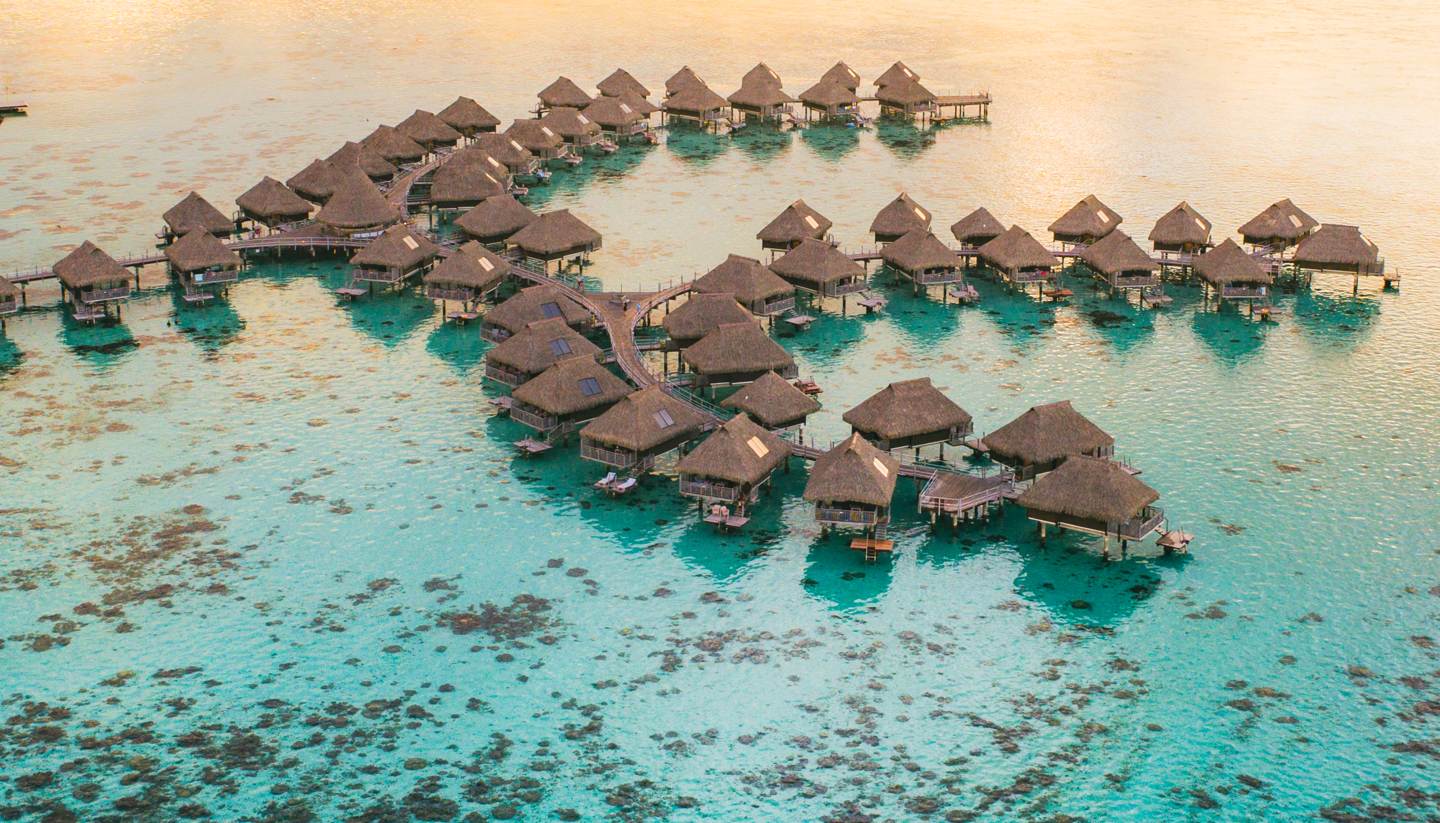

The Islands of Tahiti travel guide
About The Islands of Tahiti
The Islands of Tahiti are known for their laid-back vibes. Expect romantic sunsets and giant curls of turquoise breaking over reefs. Remote and pristine, the islands give you a glimpse of paradise on Earth.
The first Europeans to arrive on the islands were 16th-century Spanish and Portuguese explorers. After them, the British and French took control in the 18th and 19th century respectively. Tahiti, the largest island in French Polynesia is characterised by its spectacular tropical scenery, banana groves, plantations and flowers. The isle is dominated by Mount Orohena at 2,241m (7,352ft) and Mount Aorai at 2,066m (6,778ft).
You'll find plenty of colonial history on Tahiti, which became a French protectorate in 1842, and was a full colony in 1888. The other islands were annexed by the turn of the century. This status quo remained until 1946, when Polynesia was made an Overseas Territory (Territoire d'outre-mer). A revised constitution, introduced in 1977, ceded greater autonomy to the islands.
For the next 20 years, Tahiti and the islands' politics were dominated by the French nuclear testing program. By the time the program ended in 1996, 193 separate explosions had been detonated, and Tahiti had become the focus of opposition throughout the South Pacific, with plenty of protesting and riots. Although the protesters failed to stop the tests, their campaign had an important political effect by linking the anti-nuclear movement and the burgeoning pro-independence movement, which had up until then been largely unrepresented in any political forum, despite the support of a large proportion of the population.
In more recent years, changes have been afoot: The Islands of Tahiti gained Overseas Country (pays d'outre-mer or POM) status in 2004, and a few months later, pro-independence leader Oscar Temaru was elected. Since then, Tahiti has seen a few more presidents, with Édouard Fritch assuming office in 2014.
Beyond the political questions, the Islands of Tahiti offer an idyllic getaway for holidaymakers keen on sun, sand and tranquillity. And let's be honest, who isn't enticed by that alluring package?
Key facts
4,167 sq km (1,609 sq miles) - French Polynesia.
288,283 (UN estimate 2019)
67.8 per sq km.
Papeete (Tahiti Island).
Parliamentary system, Unitary state, Dependent territory
President Emmanuel Macron since 2017, represented locally by High Commissioner René Bidal since 2016.
The President of French Polynesia is Édouard Fritch since 2014.
Travel Advice
Wildfires in France
There is a high risk of wildfires during the summer season from April to October. For advice, visit the wildfires section on the Safety and security page.
Before you travel
No travel can be guaranteed safe. Read all the advice in this guide. You may also find it helpful to:
- see general advice for women travellers
- read our guide on disability and travel abroad
- see general advice for LGBT+ travellers
- read about safety for solo and independent travel
- see advice on volunteering and adventure travel abroad
Travel insurance
If you choose to travel, research your destinations and get appropriate travel insurance. Insurance should cover your itinerary, planned activities and expenses in an emergency.
About FCDO travel advice
The Foreign, Commonwealth and Development Office (FCDO) provides advice about the risks of travel, to help you make informed decisions. Find out more about FCDO travel advice.
Get travel advice updates
Sign up to get email notifications when this advice is updated.
Follow FCDO:
This information is for people travelling on a full ‘British citizen’ passport from the UK. It is based on the UK government’s understanding of the current rules for the most common types of travel.
The authorities in France set and enforce entry rules. If you’re not sure how these requirements apply to you, contact the French Embassy in the UK.
Passport validity requirements
France follows Schengen area rules. Your passport must:
-
have a ‘date of issue’ less than 10 years before the date you arrive – if you renewed your passport before 1 October 2018, it might have a date of issue that is more than 10 years ago, making it invalid for entry to the Schengen area
-
have an ‘expiry date’ at least 3 months after the date you plan to leave the Schengen area (the expiry date does not need to be within 10 years of the date of issue)
Check with your travel provider that your passport and other travel documents meet requirements. Renew your passport if you need to.
You will be denied entry if you do not have a valid travel document or try to use a passport that has been reported lost or stolen.
Dual nationals
When returning to the UK, British citizens must carry a valid British passport or certificate of entitlement. See Dual citizenship.
Visa requirements
You can travel without a visa to the Schengen area, which includes France, for up to 90 days in any 180-day period. This applies if you travel:
- as a tourist
- to visit family or friends
- to attend business meetings, cultural or sports events
- for short-term studies or training
The requirements for working in France are different.
If you’re travelling to other Schengen countries as well, make sure your whole visit is within the 90-day visa-free limit. Visits to Schengen countries in the 180 days before you travel count towards your 90 days. If you overstay the 90-day visa-free limit, you may be banned from entering Schengen countries for up to 3 years.
If you cannot return to the UK before your visa-free limit expires, contact the nearest local prefecture in France.
At French border control, you may be asked to:
- show proof of your travel insurance to demonstrate you can cover any emergency costs
- prove that you have enough money for your stay
- show proof of your accommodation
- show a return or onward ticket
Staying with family, friends or a third party
You may be asked to provide a welcome invitation (‘attestation d’accueil’) from your host. The French resident hosting you must get the attestation d’accueil from their local mayor’s office and send the original attestation before you enter France.
Second homes in France
You may need to show evidence of ownership or tenancy of your property, such as a tax or utility bill.
Staying longer than 90 days in a 180-day period
To stay longer than 90 days, you must meet the French government’s entry requirements.
If you’re in France with a residence permit or long-stay visa, this does not count towards your 90-day visa-free limit for the Schengen area.
Read about entry processes if you live in France.
New Schengen entry requirements
The European Union’s (EU) new Entry/Exit System (EES) is now being implemented across the Schengen area.
This means that when you travel into the Schengen area for short stays, you may need to register your biometric details, such as fingerprints and a photo. There is no cost for EES registration.
On your first visit into a Schengen country, you may be asked to register your details at a special booth before proceeding to the immigration desk. Follow directions from your travel operator or the staff at your port of entry. You may also need to provide either your fingerprint or photo when you leave the Schengen area. Children aged 11 or younger will not have their fingerprints scanned but can be required to have their photo taken.
You do not need to take any action before you arrive at the border on entry to the Schengen area, but EES may take each passenger extra time to complete so be prepared to wait longer than usual at the border and to allow more time for immigration controls when you depart the Schengen area. If you are departing the Schengen area by plane, allow extra time to reach your departure gate as EES checks may take place before boarding.
EES is replacing the previous system of manually stamping passports when visitors arrive in the Schengen area for short stays. You may be asked to input biometric details every time you enter or exit.
If you enter the Schengen area through the Port of Dover, Eurotunnel at Folkestone or Eurostar at St Pancras International, any information will be taken at the border before you leave the UK.
Your digital EES record is valid for 3 years.
Read more information on the EU Entry/Exit System and to understand which countries are in the Schengen area.
If you are long-term resident in a Schengen country, you are exempt from EES in all Schengen countries. The full list of EES exemptions is on the EU’s official Travel Europe website.
If you believe you have been incorrectly entered into EES or your record of time spent in the Schengen area is incorrect, approach border officials when you next cross the Schengen border and request a correction. If you are exempt, carry documentation confirming your status. If you believe your time spent in the Schengen area has been recorded incorrectly, raise this with border officials and be prepared to provide supporting evidence if requested.
Border controls at Germany’s land borders
There are temporary border controls in place to travel into Germany. Check the entry requirements for Germany.
Vaccine requirements
For details about medical entry requirements and recommended vaccinations, see TravelHealthPro’s France guide.
Customs rules
There are strict rules about goods you can take into or out of France. You must declare anything that may be prohibited or subject to tax or duty.
Taking food and drink into France
You cannot take meat, milk or products containing them into EU countries. There are some exceptions such as powdered baby milk, baby food and special foods or pet feed required for medical reasons.
Taking money into France
Declare cash or travellers cheques if the value is 10,000 euros or more. You will get a certified declaration to show you brought it in with you. If you do not, your money could be seized when you leave.
Terrorism
There is a high threat of terrorist attack globally affecting UK interests and British nationals, including from groups and individuals who view the UK and British nationals as targets. Stay aware of your surroundings at all times.
UK Counter Terrorism Policing has information and advice on staying safe abroad and what to do in the event of a terrorist attack. Find out how to reduce your risk from terrorism while abroad.
Terrorism in France
Terrorists are very likely to try to carry out attacks in France.
Terrorism attacks could be indiscriminate, including in places visited by tourists and foreign nationals such as:
- shopping centres
- entertainment establishments and nightlife venues
- sporting and cultural events
- public transport and national and international transport hubs
- places of worship
- crowded places and public gatherings
Methods of attack have included knife attacks, shootings, bombings and vehicle attacks. Be vigilant in public places and follow the advice of local French authorities.
There have been several recent high-profile terrorist attacks in France, including:
- in 2023, one person was killed in a knife and hammer attack in central Paris
- in 2023, a teacher was killed in a knife attack in a school in Arras
French authorities regularly report that they have disrupted planned attacks and made arrests.
Industrial action and demonstrations
Industrial action
There can be frequent industrial action across France. This can lead to disruption and delays on roads and public transport. If you’re due to travel to or within France, monitor the media, check your operator’s advice and follow the advice of the authorities.
Check your operator’s advice before travelling, including where you are taking connecting flights.
Demonstrations
Demonstrations, political gatherings, or marches can take place with little or no warning, particularly in cities.
Whilst most demonstrations are peaceful, if you’re near areas where they are taking place, you should remain aware of what is happening around you and follow the advice of the police and local authorities.
Crime
Protecting your belongings
Take sensible precautions against street crime and car crime. Pickpockets can work in gangs; one distracts you while the other one goes into your bag.
Thieves and pickpockets operate on the Paris Métro, on RER (train) lines and at mainline stations. To reduce the risk of theft:
- keep your passport, credit cards and other valuables in separate bags or pockets
- use the inside compartments in bags where possible
- carry your bag across your body rather than on your shoulder
- keep your belongings close to you in restaurants and bars
- do not leave any valuables in your vehicle
- do not get distracted around tourist attractions and ATMs
Assaults
There have been several cases of serious assault on the RER line B, which serves:
- Paris Charles de Gaulle airport
- Orly Airport
- Paris Gare du Nord Eurostar terminus
There have also been serious assaults on RER line D, which serves the Stade de France.
Drink spiking and sexual assault
Be alert to the possible use of ‘date rape’ and other drugs including GHB and liquid ecstasy.
Buy your own drinks and always keep them in sight to avoid them being spiked. Alcohol and drugs can reduce your vigilance, making you less in control. If you drink, know your limit. Drinks served in bars in France are often stronger than those in the UK.
Laws and cultural differences
Personal ID
You must be able to prove your identity by providing documents when asked or within 4 hours at a police station. Accepted IDs are:
- passport
- photocard driving licence
- other documentation provided by a government body
Face-covering ban
Covering your face in public places in France is illegal. This includes balaclavas, full veils or any other garment or mask that is used to hide the face. You could get a fine of up to 150 euros if you do not comply.
Forcing someone to hide their face is also a crime and is punishable by a year’s imprisonment and a fine of up to 30,000 euros. If the person forced to hide their face is aged 17 and under, the sentence is doubled. This law applies to tourists.
Illegal drugs
Illegal drugs, including cannabis, carry severe penalties including imprisonment and heavy fines for possessing, using or smuggling illegal drugs, including when transiting through airports, ports and Eurostar stations.
Airports, ports and Eurostar stations in France have excellent technology and security for detecting illegal items. This is also used to scan the baggage of transiting passengers.
Outdoor activities and adventure tourism
Swimming safety
Local sea conditions can be dangerous even for strong swimmers. Most beaches have lifeguards and flag warning systems. Make sure you understand the warning system before swimming and always follow the advice closely. See water safety on holiday from the Royal Life Saving Society.
Some beaches have strong undercurrents, especially along the Atlantic coast. There is a risk of riptides (‘baïnes’) in some areas, particularly around the coast of Gironde and Landes.
Follow local advice if there are jellyfish in the sea.
Watersports
Before taking part in water-based activities, find out how you and your friends or family will be supervised and supported.
See watersports safety advice from the Royal Society for the Prevention of Accidents (ROSPA).
Trekking and mountaineering
Check weather forecasts and conditions and make sure you’re properly prepared. Do not undertake any activity alone and consider hiring a guide for expert advice. Always leave copies of your itinerary with someone.
In mountainous areas, make sure your insurance covers you for extra costs such as mountain rescue service and helicopter evacuation. In the départements of Savoie and Haute-Savoie, you may need to be transferred to Switzerland for treatment.
Winter sports
Read advice on how to prepare for winter sports. Check current weather forecasts and avalanche risks on the Meteo France website and consider carrying avalanche search equipment if you ski off-piste.
Transport risks
Road travel
If you are planning to drive in France, see information on driving abroad and check the rules of the road in the RAC’s France guide. The guide lists driving regulations and other legal requirements you need to be aware of.
You can use a UK photocard driving licence to drive in France. If you still have a paper driving licence, you may need to update it to a photocard licence or get the correct version of the international driving permit (IDP) as well.
Check if you need a UK sticker to drive your car outside the UK. These have replaced GB stickers.
If you are visiting France, you may be able to use your Blue Badge in some circumstances. Check local parking rules.
Hire car companies often have stricter requirements for their customers, such as a year of driving experience, a higher minimum age and holding an IDP.
Penalties
Police give you on-the-spot fines for driving offences, including speeding.
France has strict drink-driving laws and the legal alcohol limit is a third lower than the limit for England and Wales. Police regularly carry out roadside checks for alcohol and drugs. Penalties include fines, loss of licence and prison.
Winter tyres and chains
Vehicles driven in certain mountain regions during the winter period (1 November to 31 March) must be fitted with winter tyres or chains. You could receive a fine if you do not comply. Visit the French public services website for more information (in English) about:
-
what type of vehicle this applies to
-
what type of tyre or chain should be fitted
-
where in France these rules apply.
Air pollution sticker
All vehicles driving in central Paris, Lyon and Grenoble must display a pollution sticker from 8am to 8pm, Monday to Friday. Checks can happen at any time, depending on pollution levels.
Some older vehicles do not qualify for a sticker at all due to their high emissions. These vehicles must not be driven in central Paris from 8am to 8pm, Monday to Friday.
Other cities may also limit vehicle access to town centres and main roads. For more information or to apply for a sticker, visit the French Ministry of Environment website.
Road safety
If you’re involved in a car accident or witness an accident on the motorway, use the orange emergency phones to ask for help.
If you are driving long distances in France:
- plan your journey carefully
- take into account unknown roads, weather conditions and fatigue
- take regular breaks
Keep vehicle doors locked in slow-moving traffic and secure your vehicle if you leave it unattended.
Information on road safety and potential traffic black spots is available on the Bison Futé website (in French). Real-time information on road traffic conditions is also available on Motorways Radio: 107.7 FM in French and in English.
Risk of people entering your vehicle
There have been attempts by people to enter private vehicles with a view to entering the UK illegally. They may target vehicles like camper vans while stationary or in slow-moving traffic. Sometimes people might try to slow down traffic on roads to ports, including by placing obstacles on the Calais Port road.
Keep car doors locked, keep moving where it’s safe to do so, and do not leave your vehicle unattended. If it is not safe to proceed, stop and call 112.
Commercial transport firms must take steps to prevent people from entering their vehicles.
Thefts from caravans and camper vans
Burglaries can happen while you are asleep in your vehicle. Take sensible precautions against vehicle break-ins. You should:
- avoid parking in isolated or dark areas of unsupervised camping grounds or car parks
- consider installing an alarm
Extreme weather and natural disasters
Find out what you can do to prepare for and respond to extreme weather and natural hazards.
Extreme temperatures
In summer months, there is a risk of higher than normal temperatures in France. Check current weather forecasts and read about how to protect yourself on the Meteo France website.
Find advice on how to stay safe in hot weather from the National Health Service (NHS).
Check with your travel provider and follow advice from local authorities.
Wildfires
Wildfires can occur across France during the summer months. The risk is highest in the south of the country, particularly along the Mediterranean coast, in Corsica, and in areas of the south-west during periods of hot, dry weather.
Check the French weather service’s fire alert map before travelling and monitor local authority advice during your stay. Conditions can change quickly and access to forests, countryside areas and tourist sites may be restricted at short notice.
Fires have become more frequent because of drought and high temperatures. French authorities may evacuate areas and close roads for safety reasons. Causing a wildfire is illegal in France, even if it is started by accident. You could get a fine or a prison sentence.
If you’re staying in, or near, a high-risk area see advice from the French government (in English) for information about:
-
what to do if a wildfire breaks out
-
how to prevent wildfire outbreaks
-
protecting your home from wildfires (including mandatory bush clearance)
If you are caught in, or witness, a wildfire, call the emergency services on 18 (fire) or 112 (emergency services).
Flooding
There is a risk of flooding in areas of France. If your accommodation is near a river, check flash flood watch (‘vigicrues’) (in French) for more information on current flood risks.
Avalanches
There is a risk of avalanches in mountainous areas. Check current weather forecasts and avalanche risks on the Meteo France website. Follow local advice before you ski or hike and consider carrying avalanche search equipment.
Conditions on roads in mountainous areas can quickly become difficult in winter. Carry water, food, warm clothing and medicines in your vehicle.
Before you travel check that:
- your destination can provide the healthcare you may need
- you have appropriate travel insurance for local treatment or unexpected medical evacuation
This is particularly important if you have a health condition or are pregnant.
Emergency medical number
Call 112 and ask for an ambulance.
Contact your insurance or medical assistance company quickly if you’re referred to a medical facility for treatment.
Vaccine recommendations and health risks
At least 8 weeks before your trip:
- check the latest vaccine recommendations for France
- see where to get vaccines and whether you have to pay on the NHS travel vaccinations page
See what health risks you’ll face in France, including:
- dengue
- chikungunya
- biting insects and ticks
Altitude sickness is a risk in parts of France. Read more about altitude sickness on TravelHealthPro.
Medication
The legal status and regulation of some medicines prescribed or bought in the UK can be different in other countries.
Read best practice when travelling with medicines on TravelHealthPro.
Healthcare in France
FCDO has a list of hospitals in major cities including Paris, Marseille and Bordeaux region where some staff will speak English.
Health insurance cards
To get medically necessary state healthcare in France, you need a Global Health Insurance Card (GHIC) or a valid existing European Health Insurance Card (EHIC).
The NHS’s getting healthcare abroad webpage has details about:
- how to apply for a GHIC
- how to get temporary cover if you lose your card or it does not arrive in time
- who qualifies for a new EHIC instead of a GHIC
- what treatment counts as medically necessary
State healthcare in France is not always free. Treatment is on the same basis as for French citizens.
A GHIC or EHIC is not an alternative to travel insurance. You may have costs your GHIC or EHIC does not cover, including:
- changes to travel and accommodation bookings
- additional standard costs for treatment
- medical repatriation to the UK
- treatment that is ruled non-urgent
- private healthcare
- private clinics
There is also guidance on healthcare if you’re living in France.
Travel and mental health
Read FCDO guidance on travel and mental health. There is also mental health guidance on TravelHealthPro.
The Foreign, Commonwealth & Development Office (FCDO) cannot provide tailored advice for individual trips. Read this travel advice and carry out your own research before deciding whether to travel.
Emergency services in France
Telephone 112 (ambulance, fire, police)
Ambulance: 15
Fire: 18
Police: 17
Deaf and hard of hearing emergency number (SMS, chat, video and fax): 114
Contact your travel provider and insurer
Contact your travel provider and your insurer if you are involved in a serious incident or emergency abroad. They will tell you if they can help and what you need to do.
Refunds and changes to travel
For refunds or changes to travel, contact your travel provider. You may also be able to make a claim through insurance. However, insurers usually require you to talk to your travel provider first.
Find out more about changing or cancelling travel plans, including:
- where to get advice if you are in a dispute with a provider
- how to access previous versions of travel advice to support a claim
Support from FCDO
FCDO has guidance on staying safe and what to do if you need help or support abroad, including:
- finding English-speaking lawyers, funeral directors and translators and interpreters in France
- dealing with a death in France
- being arrested in France
- getting help if you’re a victim of crime
- what to do if you’re in hospital
- if you are affected by a crisis, such as a terrorist attack
Contacting FCDO
Help abroad
See how to get help from the UK government abroad including in an emergency.
Help in the UK
You can call FCDO in London if you need urgent help because something has happened to a friend or relative abroad.
Telephone: 020 7008 5000 (24 hours)
Get travel advice updates
Sign up to get email notifications when this travel advice is updated.
Follow FCDO:
Risk information for British companies
The Overseas Business Risk service offers information and advice for British companies operating in France on how to manage political, economic, and business security-related risks.