
Maldives travel guide
About Maldives
The Maldives is a by-word for luxury, romance and tropical bliss. A beautiful string of low-lying coral islands in the Indian Ocean, they're also a paradise for diving enthusiasts and sun-seekers alike.
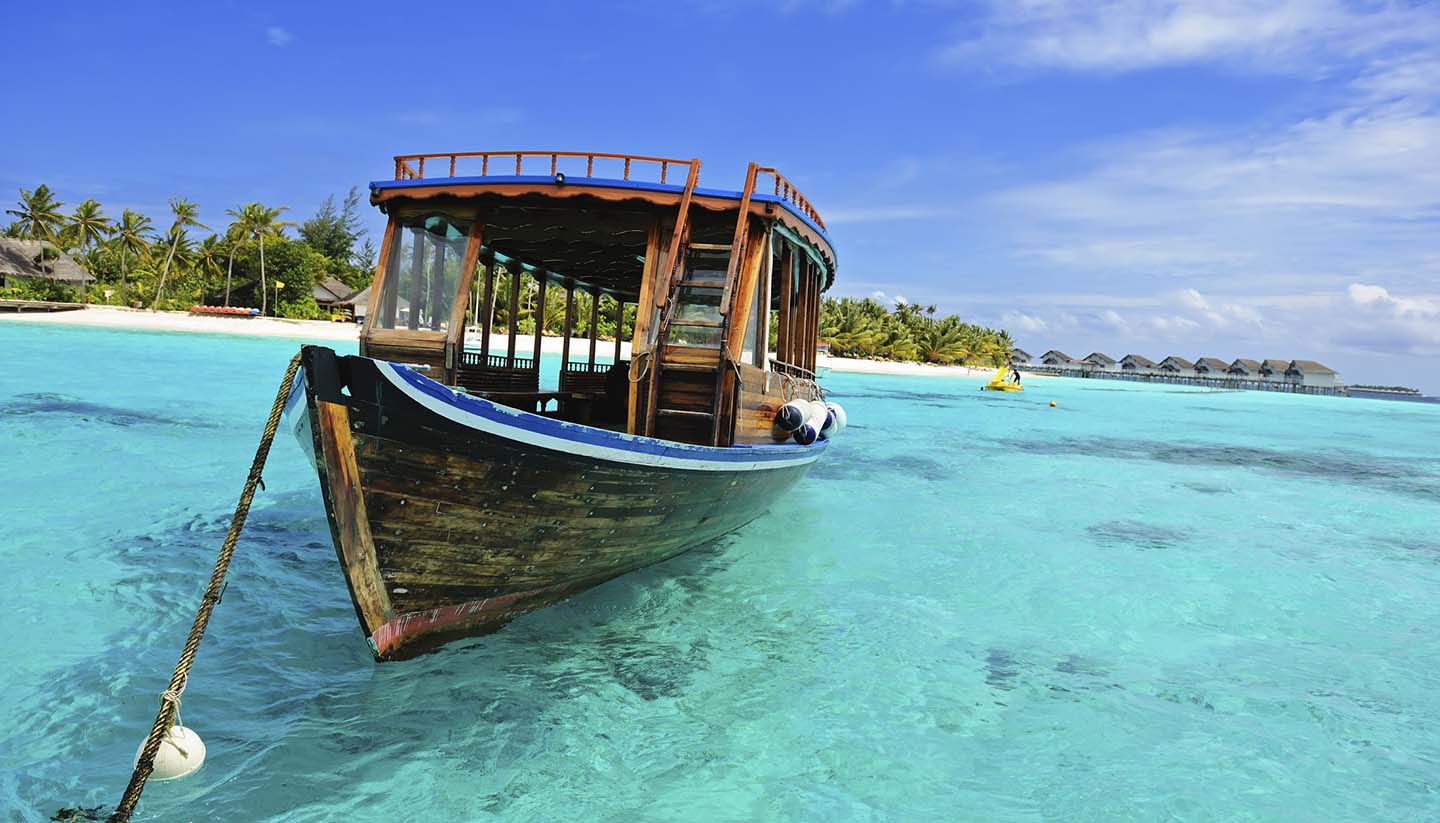
The country's 26 natural atolls and over 1,000 islands boast uniformly perfect coasts dropped like pearls in the warm waters of turquoise blue lagoons. With bright white powdery sand fringing most of the islands, it’s not surprising that over a million visitors come here each year.
The tourism industry began to blossom in the 1970s and now is the Maldives’ most lucrative industry. The luxury market is its unique selling point, and it is home to some of the world’s best hotels. Pretty much every resort has its own private island, complete with personal butlers and in-room massages. Such opulence has made it a firm favourite with honeymooners, who revel in the possibility of escaping to a romantic haven. The islands also offer slightly less pricey options, and some resorts are aimed at families and divers.
The Maldives are extremely low lying (80% of the territory is less than 1m/3.3ft above sea level). As such, the islands have worked hard to become one of the most environmentally friendly countries on earth and continue to so. Luxury and tourism have often been essential in providing economic benefits to local inhabitants who struggle to utilise local resources.
Recently, it has become more feasible on the Maldives for independent travellers and backpackers to avoid the luxury hotels and stay among the local people. The growing number of private guesthouses may well give the Maldives a new lease of life away from big-money tourism. What luxury means, after all, is in the eye of the beholder.
Key facts
298 sq km (115 sq miles).
515, 596 (World Bank estimate, 2018).
1,102.5 per sq km (2,855.5 per sq miles).
Malé.
Republic.
President Mohamed Muizzu since 2023.
President Mohamed Muizzu since 2023.
Travel Advice
Global travel impacts due to the situation in the Middle East
Escalation in the Middle East has caused widespread travel disruption, including airspace closures, delayed and cancelled flights. This may impact connections to and from the Maldives.
Your travel plans may be affected, even if your destination is not in the Middle East. Before you travel:
- check travel advice for any countries or territories you are transiting through
- check for the latest updates from your airline or tour operator
- review your travel insurance policy to confirm what is covered
- monitor local and international media and sign up for FCDO travel advice email alerts
Hotline number Ministry of Tourism and Environment: +9609423131
Before you travel
No travel can be guaranteed safe. Read all the advice in this guide. You may also find it helpful to:
- see general advice for women travellers
- read our guide on disability and travel abroad
- see general advice for LGBT+ travellers
- read about safety for solo and independent travel
- see advice on volunteering and adventure travel abroad
Travel insurance
If you choose to travel, research your destinations and get appropriate travel insurance. Insurance should cover your itinerary, planned activities and expenses in an emergency.
About FCDO travel advice
The Foreign, Commonwealth & Development Office (FCDO) provides advice about risks of travel to help you make informed decisions. Find out more about FCDO travel advice.
Get travel advice updates
Sign up to get email notifications when this travel advice is updated.
Follow FCDO:
This information is for people travelling on a full ‘British citizen’ passport from the UK. It is based on the UK government’s understanding of Maldives’ current rules for the most common types of travel.
The authorities in Maldives set and enforce entry rules. If you’re not sure how these requirements apply to you, contact the Maldivian High Commission in the UK.
Passport validity requirements
Your passport must have an ‘expiry date’ at least one month after the date you arrive in Maldives. Make sure your passport is not damaged or you may be stopped by immigration.
Check with your travel provider that your passport and other travel documents meet requirements. Renew your passport if you need to.
You will be denied entry if you do not have a valid travel document or try to use a passport that has been reported lost or stolen.
Dual nationals
When returning to the UK, British citizens must carry a valid British passport or certificate of entitlement. See Dual citizenship.
Visa requirements
You will get a 30-day visa on arrival if you enter Maldives as a tourist.
If you intend to work in Maldives, you must get a work visa before you travel.
For further information on entry requirements and visas, contact the Maldives immigration department.
Traveller declaration form
You must complete a traveller declaration form (IMUGA) within 96 hours before your flight arrives in the Maldives.
Vaccine requirements
To enter Maldives, you must have a certificate to prove you’ve had a yellow fever vaccination if you’re coming from a country listed as a transmission risk.
For full details about medical entry requirements and recommended vaccinations, see TravelHealthPro’s Maldives guide.
Customs rules
There are strict rules about goods you can take into or out of Maldives. You must declare anything that may be prohibited or subject to tax or duty.
It is illegal to bring in anything deemed contrary to Islam, including ‘idols for worship’, bibles, pork and pork products, and alcohol.
Terrorism
There is a high threat of terrorist attack globally affecting UK interests and British nationals, including from groups and individuals who view the UK and British nationals as targets. Stay aware of your surroundings at all times.
UK Counter Terrorism Policing has information and advice on staying safe abroad and what to do in the event of a terrorist attack. Find out how to reduce your risk from terrorism while abroad.
Terrorism in Maldives
Terrorist attacks in Maldives cannot be ruled out.
Attacks could be indiscriminate, including in places visited by foreign nationals. Stay aware of your surroundings, keep up to date with local media reports and follow the advice of local authorities.
Terrorist groups, such as Al-Qaida and Daesh, have called on their supporters to carry out terrorist attacks in response to the conflict in Israel and Palestine. The conflict could also motivate individuals to carry out attacks, including in Maldives.
The Maldivian authorities have disrupted a number of terrorist attack plans since 2017 and have made several arrests relating to attack planning, recruitment of terrorist fighters and spreading extremist ideology. However, a risk from terrorism remains.
Examples of attacks in the last 5 years include:
- in 2025, a terrorist plot was foiled. Suspects are awaiting trial.
- in 2022, a politician was attacked with a knife and injured in the Hulhumalé area of Malé
- in 2021, a high-profile politician and a number of bystanders were injured by the detonation of an improvised explosive device (IED) in central Malé
- in 2020, an arson attack on a police speedboat in Laamu Gan
- in 2020, knife attacks that injured 3 foreigners in Hulhumalé which were claimed by Daesh supporters
Political situation
Political protests take place occasionally in Malé. Avoid any protests or rallies to ensure your safety and security.
Crime
Crime levels are low in the exclusive resort islands, but petty crime does happen. Do not leave items unattended on the beach or in unlocked hotel rooms.
Outside the resorts, there are incidents of gang-related violence including knife crime, mainly in Malé and in Hulhumalé. Avoid empty roads when on foot, particularly after dark.
Laws and cultural differences
Maldives is an Islamic country. It is illegal to publicly observe a religion other than Islam. Make sure that your actions do not offend, especially during Ramadan or when visiting religious areas around mosques. If you break local laws, you may get a prison sentence.
Ramadan
Ramadan is a holy month for Muslims. The dates vary by year and country. In 2026, it began on 17 February and finished on 19 March. In 2027, it may start on 7 February and last for 29 or 30 days.
During this time, do not eat, drink or smoke in public in the daytime, outside of holiday resorts.
Get more advice when you arrive from your tour guide, hotel or business contacts.
Alcohol laws and bans
Alcoholic drinks are only available on resort islands. Do not take any alcohol out of your resort. You can be arrested and deported for possessing and drinking alcohol, or being intoxicated outside resorts and on inhabited islands.
Illegal drugs penalties
Possession, trafficking and manufacture of any illegal drugs are serious offences in Maldives and penalties can be severe. This includes cannabis, even small quantities can lead to arrest.
British nationals have been caught carrying controlled drugs while transiting Maldives.
International airports in Maldives have advanced scanning systems and procedures in place for scanning and detecting illegal substances, including cannabis. This includes all carry-on and checked-in baggage of transiting passengers.
The Maldivian authorities have a zero-tolerance policy to drug offences. Possessing drugs, even in very small quantities, carries severe penalties, including:
- arrest and detention
- long prison sentences if convicted
- corporal punishment (whipping) in some cases
- death penalty for the most serious offences
You are strongly advised:
- not to carry any controlled substances, including cannabis, even if legal in your departure country
- to check your luggage thoroughly before travelling or transiting through the Maldives
- if prescribed medication contains controlled substances, carry a doctor’s prescription and check Maldivian regulations in advance
Wildlife, animal products and souvenirs
It is illegal to take tortoiseshell jewellery or ornaments, or pieces of coral out of Maldives.
LGBT+ travellers
Same-sex relations are illegal and if you are convicted, you could get a fine or a lengthy prison sentence.
Read more advice for LGBT+ travellers.
Local dress standards
You should be sensitive to local dress standards when outside holiday resorts, including on beaches used by locals. Men and women should:
- have shoulders covered
- avoid short or tight-fitting shorts
- have arms and upper legs covered when bathing
Nudism and topless sunbathing are not allowed anywhere, including on resort islands.
Outdoor activities and adventure tourism
Swimming safety
The sea around Maldives can have strong tidal currents that can drag you away from the shoreline resulting in drownings. It is important that you know the risks and what you can do to minimise them. Always speak to the appropriate resort staff to find out where it is safe for you to swim.
You should read the security information provided by your tour operator and make yourself aware of local swimming conditions on arrival at the resort. Keep in regular contact with resort staff to see if these conditions change.
Only swim in well supervised areas, areas designated as safe for tourists, or where lifeguards are available. Pay attention to warning signs or flags and avoid swimming in areas with strong currents, high waves or dangerous underwater conditions. If something does not feel right, get out of the water at the earliest opportunity.
Being aware of the potential dangers will help you to stay safe. Always take local advice before going into the sea.
There have been fatal accidents involving boat propellers in the South Ari Marine Protected Area (SAMPA) and nearby whale shark tourism sites. Regulations requiring propeller guards are not yet fully enforced. Take extra care when swimming or snorkelling near boats and follow local safety instructions.
See water safety on holiday from the Royal Life Saving Society.
Scuba diving
Many resort islands are more than an hour away from the nearest hyperbaric chamber. Make sure you understand how your dive operator would get you to one of the 3 chambers in the islands.
Diving safaris are available and may include opportunities to see sharks. Be aware of the potential risks as accidents can occur and, in rare cases, may be fatal.
Transport risks
Road travel
If you are planning to drive a car in Maldives, see information on driving abroad.
You’ll need to have both the correct version of the international driving permit (IDP) and your UK driving licence with you in the car. You cannot buy an IDP outside the UK, so get one before you travel.
Hire car companies often have stricter requirements for their customers, such as a year of driving experience and minimum age 20 or 21.
Sea travel
There is a high risk of piracy and armed robbery in the Gulf of Aden and Indian Ocean.
There have been attacks on local fishing sailing vessels (dhows) in the Gulf of Aden and Horn of Africa.
If you’re travelling by sea, read about the regional risks at sea.
Most of the island resorts are accessible by boat. Pay attention to safety briefings when taking any boat trips. Make sure life jackets are provided, especially on smaller excursion boats. Some tour guides may be able to advise on the safety record and registration of boats.
Extreme weather and natural disasters
Flooding
Flash flooding can affect low-lying islands during periods of heavy rain. Follow the advice of the local authorities.
Find out what you can do to prepare for and respond to extreme weather and natural hazards.
Before you travel check that:
- your destination can provide the healthcare you may need
- you have appropriate travel insurance for local treatment or unexpected medical evacuation
This is particularly important if you have a health condition or are pregnant.
Emergency medical number
Dial 102 and ask for an ambulance.
Contact your insurance company quickly if you’re referred to a medical facility for treatment.
Vaccine recommendations and health risks
At least 8 weeks before your trip:
- check the latest vaccine recommendations for Maldives
- see where to get vaccines and whether you have to pay on the NHS travel vaccinations page
See what health risks you’ll face in Maldives, including:
- dengue
- measles
Medication
The legal status and regulation of some medicines prescribed or bought in the UK can be different in other countries.
Read best practice when travelling with medicines on TravelHealthPro.
Healthcare in Maldives
Medical facilities are limited – the only fully equipped hospitals are in Malé and Hulhumalé. Most resort islands are within reach of a doctor or have their own medical facilities, but many are several hours’ travel away from emergency treatment.
FCDO has a list of medical providers in Maldives where some staff will speak English.
There is also guidance on healthcare if you’re living in Maldives.
Travel and mental health
Read FCDO guidance on travel and mental health. There is also mental health guidance on TravelHealthPro.
The Foreign, Commonwealth & Development Office (FCDO) cannot provide tailored advice for individual trips. Read this travel advice and carry out your own research before deciding whether to travel.
Emergency services in Maldives
Ambulance: 102
Fire: 118
Police: 119
Contact your travel provider and insurer
Contact your travel provider and your insurer if you are involved in a serious incident or emergency abroad. They will tell you if they can help and what you need to do.
Refunds and changes to travel
For refunds or changes to travel, contact your travel provider. You may also be able to make a claim through insurance. However, insurers usually require you to talk to your travel provider first.
Find out more about changing or cancelling travel plans, including:
- where to get advice if you are in a dispute with a provider
- how to access previous versions of travel advice to support a claim
Support from FCDO
FCDO has guidance on staying safe and what to do if you need help or support abroad, including:
- finding lawyers in Maldives
- dealing with a death in Maldives
- being arrested or imprisoned in Maldives
- getting help if you’re a victim of crime
- what to do if you’re in hospital
- if you’re affected by a crisis, such as a terrorist attack
Contacting FCDO
Help abroad
See how to get help from the UK government abroad including in an emergency.
Help in the UK
You can call FCDO in London if you need urgent help because something has happened to a friend or relative abroad.
Telephone: 020 7008 5000 (24 hours)
Get travel advice updates
Sign up to get email notifications when this travel advice is updated.
Follow FCDO: