
Getting Around Thailand
Air
Flying is one of the quickest ways to cover long distances within Thailand, especially when travelling between Bangkok, the north and the southern islands. The country has an extensive network of domestic routes operated by both full-service and low-cost carriers, with frequent flights linking major cities and tourist regions.
Bangkok's two airports, Suvarnabhumi (BKK) and Don Mueang (DMK), serve as the main hubs for domestic air travel. Suvarnabhumi handles most full-service carriers, including Thai Airways and Bangkok Airways, while Don Mueang is the base for low-cost airlines such as AirAsia, Nok Air and Thai Lion Air. Both airports offer regular connections to Chiang Mai, Chiang Rai, Phuket, Krabi, Hat Yai, Udon Thani and many other destinations.
Several regional airports make it easy to reach more remote areas. Chiang Mai (CNX) is the northern hub, providing links to Bangkok and other northern provinces. Phuket (HKT) and Krabi (KBV) serve the Andaman coast, while Samui (USM) connects travellers to the Gulf of Thailand, although flights to and from Samui can be more limited due to airport capacity. Other useful airports include Udon Thani (UTH), Surat Thani (URT) and Trang (TST).
Flights are generally reliable, although schedules can change during the monsoon season, particularly in the south. Low-cost airlines often offer competitive fares but may charge extra for baggage, seat selection and other services, so it is worth checking the details when booking.
Road
Thailand has an extensive road network that links its major cities, provincial towns and rural districts, making overland travel straightforward for most itineraries. The main highways radiate from Bangkok and reach every region of the country, from the mountainous north to the fishing towns and island gateways of the south. Scenic stretches appear often, whether it is a run past rice fields in the central plains, winding slopes in Chiang Mai province or coastal routes skirting mangrove forests and quiet beaches. Road journeys offer opportunities for spontaneous discoveries, from a village market with fresh fruit to a roadside stall serving noodles or grilled chicken.
Traffic in large cities can be unpredictable, with Bangkok in particular known for long queues and slow-moving routes at peak times. Once outside the urban centres, driving becomes more manageable and road conditions on major routes are generally good, although smaller rural roads may be narrow or uneven in places. Travel times can be longer than expected during the rainy season, when heavy downpours or roadworks may cause delays. Despite this, travelling by road remains an appealing way to see the country at a steady pace, with plenty of chances to stop, wander and take in the landscapes along the way.
Side of the road
LeftRoad Quality
Road quality in Thailand varies widely between regions, but the main highways are generally in good condition and allow for smooth intercity travel. Major routes are paved, clearly signposted and regularly maintained, especially those linking Bangkok with Chiang Mai, Phuket, Hat Yai and key provincial capitals. Dual carriageways are common on well-travelled corridors, and many long-distance routes have rest stops, fuel stations and convenience stores at regular intervals.
Conditions can change once you move onto secondary or rural roads. Some are narrow, uneven or affected by seasonal wear, particularly in mountainous areas of the north and forested regions in the south. Heavy rain during the monsoon months may lead to potholes, surface damage or temporary flooding. Drivers should be cautious after dark, as street lighting is limited outside towns. Despite these challenges, most travellers find the country's main roads reliable, and improvements continue across many regions.
Road Classification
Thailand's roads fall into several categories, each managed by different authorities. National Highways, overseen by the Department of Highways, form the backbone of the network and connect major cities and regions. These roads are marked with white route numbers on black backgrounds and are usually well-maintained. Rural Roads, managed by the Department of Rural Roads, provide links between smaller towns and villages and may vary more in width and condition.
Local roads, under the responsibility of provincial or municipal authorities, serve neighbourhoods and outlying communities. These can range from paved streets to simple concrete or gravel tracks. Toll roads operate mainly around Bangkok and some intercity corridors, offering faster and more predictable travel, although toll fees apply. Understanding these classifications helps travellers plan routes more effectively, particularly when venturing beyond the main highways.
Car Hire
Car hire is widely available in Thailand, especially in major cities, airports and popular tourist areas such as Bangkok, Chiang Mai, Phuket and Krabi. Both international and local rental companies operate throughout the country, offering everything from compact cars to larger vehicles suitable for families or groups. Rates are generally competitive, and advance booking is recommended during peak travel periods.
While self-drive is possible, many visitors prefer to hire a car with a driver, particularly for longer journeys or trips into rural or mountainous regions. Traffic in cities can be heavy and unpredictable, and navigating unfamiliar areas may feel stressful for those not used to local driving habits. Hiring a driver is relatively affordable and allows travellers to enjoy the scenery without the pressure of managing road conditions or parking. Drivers often know the quickest routes and can offer helpful suggestions for sightseeing or meal stops along the way.
Foreigners who wish to drive themselves must have a valid driving licence and an International Driving Permit (IDP). Rental companies typically require both documents, along with a passport and a credit card for the deposit. Insurance coverage varies between providers, so it is sensible to check what is included and consider additional cover if necessary.
Taxi
Taxis are plentiful in Thailand's major cities and are a convenient way to get around, especially for travellers who prefer to avoid navigating busy roads or deciphering public transport routes. In Bangkok, taxis are metered and usually easy to flag down, although traffic can slow journeys considerably. Visitors should ensure the driver switches on the meter at the start of the trip, as fixed prices offered to tourists are often higher than the official fare. Unmarked taxis are best avoided.
Ride-hailing apps have become very popular and are often the easiest option for both locals and visitors. Grab is the dominant platform, offering car rides, motorbike rides and food delivery, with upfront pricing and cashless payments. Bolt also operates in Bangkok and some other cities, providing an alternative with competitive rates. These apps are particularly useful for travellers, as they eliminate fare negotiation and allow booking in English.
Motorbike taxis are a quick and efficient way to move through congested areas, especially in Bangkok. They can be identified by the bright-coloured vests worn by licensed drivers and are commonly found at street corners, stations and markets. Motorbike taxi rides can also be booked through apps in many areas. For drivers operating independently without an app, it is important to agree on the fare before setting off.
Bike
Thailand can be an enjoyable country to explore by bicycle, particularly outside the busiest urban areas. While heavy traffic in cities such as Bangkok and Chiang Mai may feel intimidating, cycling becomes far more pleasant in quieter towns, along rural backroads, on coastal stretches or through national parks and countryside dotted with rice fields and small villages. The flatter landscapes of central and northeastern Thailand suit relaxed rides, while the northern highlands offer more challenging routes with rewarding views.
Bicycles can be rented in many tourist destinations, especially in Chiang Mai, Ayutthaya, Sukhothai, Pai and several islands. Rental rates are usually affordable, and guesthouses often offer basic bikes for short rides around town. Cycling in large cities is generally more comfortable during early mornings, when temperatures are cooler and traffic is lighter.
For long-distance cycling or bikepacking, Thailand has a number of appealing routes, including sections of the coastal roads in the south and scenic loops around Chiang Mai and Mae Hong Son. Cyclists should be prepared for changes in road quality, occasional steep climbs in northern provinces and hot, humid weather for much of the year. Carrying sufficient water and using sun protection are essential, especially during the hotter months.
Coach
Thailand has an extensive network of long-distance buses connecting major cities, provincial capitals and smaller towns throughout the country. Services range from basic government-operated buses to more comfortable VIP coaches with large reclining seats, air-conditioning and onboard amenities. These buses cover a wide range of routes, making it possible to travel almost anywhere by road.
Both state-run and private companies operate intercity services. The Transport Company (BorKhorSor) is the main government operator and runs reliable routes nationwide. Private companies also serve popular corridors, offering frequent departures, online booking options and varying levels of comfort. Routes between Bangkok and Chiang Mai, Phuket, Krabi, Udon Thani and Surat Thani are among the busiest and most commonly used by visitors.
Most cities have dedicated long-distance bus terminals, and Bangkok has several, including Mo Chit for northern and northeastern routes, Ekkamai for services to the east and Southern Bus Terminal (Sai Tai Mai) for the south and west. During weekends and holidays, advance booking is recommended, as seats can fill quickly. Some operators offer hotel pick-up services in tourist areas, while others require passengers to make their own way to the terminal.
Night buses are a popular option for covering long distances and making efficient use of time. While sleeping conditions vary depending on the class of bus, the journey is generally comfortable enough for most travellers. Road conditions can differ across regions, but long-distance bus travel remains an affordable and convenient way to explore Thailand on a budget.
Regulations
Speed limits in Thailand depend on the type of road and vehicle. In urban areas, the limit is generally 50 km/h (31 mph) unless otherwise indicated. On rural roads, cars may travel at 80–90 km/h (50–56 mph), while on motorways and expressways the limit usually ranges from 100–120 km/h (62–75 mph). Speed cameras are increasingly common, and limits are signposted along major routes.
Thailand has strict drink-driving laws. The legal blood alcohol limit for most drivers is 0.05%, and for drivers of motorcycles, public transport vehicles and drivers under 20 years old, the limit is effectively zero. Police conduct random breath tests, particularly during holidays and late at night, and penalties include substantial fines, licence suspension and possible imprisonment in serious cases.
Seat belts are mandatory for drivers and all passengers in the front seats. Rear-seat passengers are also required to wear seat belts, although enforcement may be uneven. Helmets are compulsory for all motorbike riders and passengers, and this rule is widely enforced. Using a mobile phone while driving is prohibited unless using a proper hands-free setup.
Traffic in Thailand drives on the left-hand side of the road. Overtaking is common and can be unpredictable, especially on busy highways or rural roads, so defensive driving is essential. Visitors choosing to drive should remain alert, keep a safe distance from other vehicles and be prepared for sudden lane changes or motorbikes weaving through traffic.
Breakdown services
Thailand does not have a single nationwide breakdown service, but many car insurance policies include some form of roadside assistance. Travellers hiring a car should check in advance whether towing, on-site repairs or emergency help are included in the rental agreement or insurance package.
For motorbikes, assistance is often informal. Small, family-run mechanics can be found in most towns and along many rural roads, and they are usually able to help with punctures, chain issues or minor engine problems. In more remote areas, help may take longer to reach you, so it is sensible to travel with basic tools or ensure your rental provider offers support.
Documentation
To legally drive in Thailand, visitors generally need the following:
• A valid driving licence from their home country, accompanied by an International Driving Permit (IDP) issued under the 1949 Convention. Most rental companies require both documents, along with a passport and a credit card for the deposit.
• Travellers staying long-term may apply for a Thai driving licence. This can be issued to foreigners holding the appropriate visa and residency documents, and requires presenting the home-country licence, a medical certificate and proof of address.
For motorbike riders, the licence must specifically cover motorbikes. An IDP without a motorcycle endorsement is not accepted for riding motorbikes in Thailand, even small ones. Riding without the correct licence can result in fines and may also affect insurance coverage in the event of an accident.
Urban travel
Getting around cities in Thailand is lively and often colourful, with a mix of modern transport options and long-established local favourites. In Bangkok, Chiang Mai, Phuket and other large cities, motorbikes are a common sight and remain one of the quickest ways to weave through heavy traffic. Visitors can hire motorbikes where permitted, although many prefer to rely on motorbike taxis or ride-hailing apps for convenience and safety.
Public buses operate in most urban centres, including Bangkok, where an extensive network covers the city and its suburbs. Buses are inexpensive but can be confusing for newcomers due to complex routes and varying service types, some with air-conditioning and others without. Bangkok also has the BTS Skytrain and MRT underground, offering fast, reliable alternatives for crossing the city. These rail systems have become essential for navigating Bangkok's busiest districts.
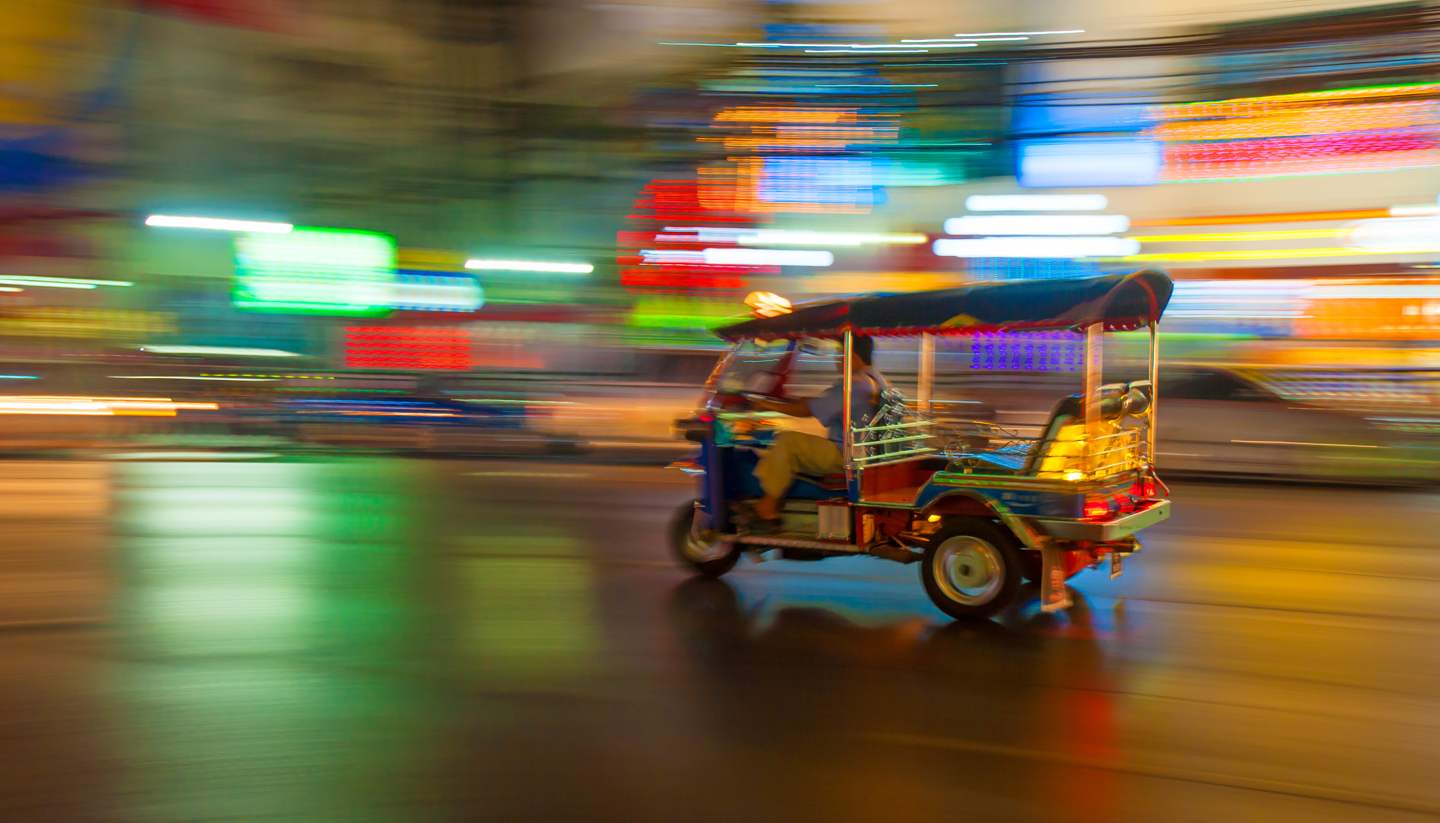
In addition to buses and trains, cities offer a range of local transport. Tuk-tuks are iconic three-wheeled vehicles commonly found in Bangkok and other tourist areas. They provide a fun, short-hop option, though fares should be agreed upon before the journey. Songthaews, essentially pick-up trucks with bench seating, operate on fixed routes in many cities and towns and are widely used by locals for everyday travel.
Walking is possible in many central districts, particularly in areas with shops, markets and riverfront promenades. Pavements can be uneven or crowded in some places, and the heat can be intense, so short distances are usually more comfortable. Despite the challenges, wandering on foot can be a pleasant way to explore local neighbourhoods at a relaxed pace.
For many visitors, the most convenient options in urban areas remain taxis and ride-hailing apps such as Grab and Bolt. These services offer predictable pricing and are widely available in major cities, making them an easy and reliable way to move between attractions.
Rail
The State Railway of Thailand (SRT) operates all regular passenger services in the country. Thailand’s rail network radiates from Bangkok and consists of four main lines: the Northern Line to Chiang Mai, the Northeastern Line to Udon Thani and Nong Khai, the Eastern Line to Aranyaprathet and the Cambodian border region, and the Southern Line, which runs through Hua Hin, Surat Thani and Hat Yai before continuing towards the Malaysian border. These lines serve a wide range of destinations and make rail travel a practical option for covering long distances.
The Northern Line between Bangkok and Chiang Mai is one of the most popular routes for travellers. Overnight sleeper trains are available, offering air-conditioned berths in various classes. The Southern Line is equally important, providing rail access to key transport hubs such as Surat Thani (for ferries to Koh Samui, Koh Phangan and Koh Tao) and Hat Yai. The Northeastern Line connects Bangkok with historic towns and the Mekong region, making it useful for those heading towards Laos.
Thailand has introduced more modern rolling stock in recent years, particularly on long-distance routes, improving comfort with cleaner cabins, better air-conditioning and more reliable services. While travel times can be slower than by road or air, trains offer a relaxed way to experience the countryside and avoid heavy traffic in major cities.
For shorter journeys, commuter rail services operate around Bangkok, and the Airport Rail Link provides a swift connection between Suvarnabhumi Airport and central districts. Travelling by rail in Thailand is generally affordable and gives visitors an opportunity to enjoy the landscapes at an unhurried pace.
Water
Water transport plays an important role in reaching Thailand's many islands and coastal destinations. A wide range of ferries, speedboats and long-tail boats operate throughout the Gulf of Thailand and the Andaman Sea, providing essential links between the mainland and popular islands such as Phuket, Koh Samui, Koh Phangan, Koh Tao, Koh Lanta and Koh Phi Phi. Services vary by season, with more frequent departures during the dry months and possible disruptions during the monsoon period.
On the Gulf coast, ferries from Surat Thani and Chumphon connect to the Samui archipelago. High-speed catamarans and passenger ferries run several times a day, and journey times depend on sea conditions and the type of vessel. Along the Andaman coast, routes between Phuket, Krabi, Koh Phi Phi and Koh Lanta are especially well used, with a mix of large ferries and smaller speedboats available.
Long-tail boats are common for short hops between nearby islands or for accessing beaches and bays that are not reachable by road. These traditional wooden boats offer a scenic, if sometimes bumpy, way to travel. Fares are usually fixed on popular routes, though they may rise in bad weather or during peak holiday periods.
In Bangkok, water transport forms part of the city's wider public transport system. The Chao Phraya Express Boat, tourist boats and smaller canal ferries (khlong boats) provide efficient alternatives to road travel, especially during rush hours. These services connect major tourist areas, historic districts and residential neighbourhoods along the city's waterways.
Domestic water travel is generally safe and reliable, but travellers should check schedules in advance, particularly during the rainy season, and follow safety instructions when boarding small boats or travelling in rough seas.